Services
The Federal Parliament, finally readable.
An AI-powered open data platform that makes Belgian parliamentary work understandable, trackable, and accountable by turning complex parliamentary data into clear, neutral, source-backed intelligence.
Making the Parliament make sense. Making politics open, accessible, understandable, accountable. The first AI-powered neutral mirror for Belgian political accountability.
What we do
We turn parliamentary complexity into clarity.
We transform fragmented parliamentary data into structured, source-based insights, helping citizens, journalists, NGOs, and businesses finally understand what happens inside the Belgian Federal Parliament — and what it means in practice.
- 01
Accessible
It creates transparency in the Belgian political system.
- 02
Understandable
We use AI to summarize and structure information neutrally.
- 03
Accountable
We provide the public, journalists, and stakeholders with reliable tools and data to monitor parliamentary activity and make civic oversight easier.
Inside the platform
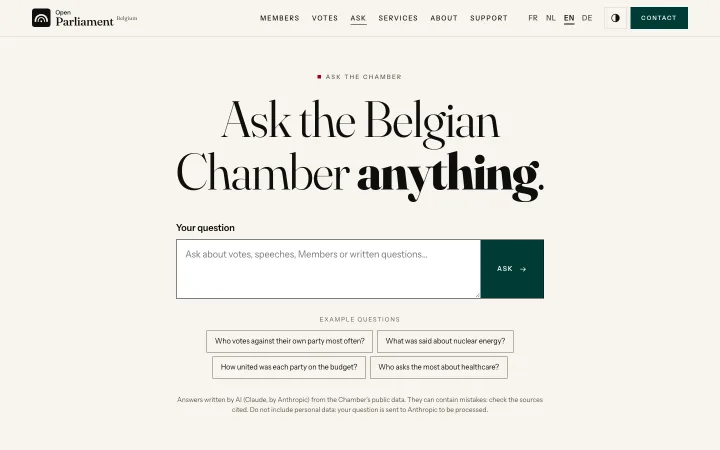
A look at the tool.









How it works
From the Chamber’s records to a plain answer.
The work of parliament is public, but spread across thousands of documents almost nobody reads. Open Parliament turns them into structured data an assistant can reason over.
- 01
Official records
Plenary and committee transcripts, roll-call votes, written questions and the member registry, collected from dekamer.be and updated regularly.
- 02
One connected graph
Members, parties, votes, bills, questions and speeches are linked, with each Member’s party resolved as it stood on the day of every event.
- 03
Traceable answers
The assistant queries this data and cites the source document behind every claim, so you can check it yourself.
Who it is for
For everyone who wants to see what the Parliament does.
- 01
Citizens
Understand what is debated and decided in your name, and what it means in practice.
- 02
Journalists
Monitor parliamentary activity and go straight back to the source.
- 03
NGOs
Follow the issues your cause depends on, without digging through scattered documents.
- 04
Public affairs professionals
Track parliamentary work in a structured, neutral way.
- 05
Academia
Work from structured, source-based parliamentary data.
- 06
Political parties
See parliamentary work reflected in a neutral, constructive mirror.
FAQ
Questions, answered.
What is Open Parliament?
An independent, AI-powered open data platform. It turns complex parliamentary data into clear, neutral, source-backed intelligence, so anyone can see what happens inside the Belgian Federal Parliament.
Who is it for?
Citizens, journalists, NGOs, public affairs professionals, academics and political parties: anyone who wants to monitor parliamentary activity.
Where does the information come from?
From public political data published by the Belgian Federal Parliament. Insights stay linked to their sources, so you can always check the original.
How do you keep the AI neutral?
We use AI to summarize and structure information, not to persuade. Insights are delivered without spin, bias, or party preference, and remain verifiable against their sources.
How do you comply with the EU AI Act?
The AI Act requires AI systems that interact with the public to be transparent. Our assistant is clearly presented as an AI system, every answer cites its official sources and carries a machine-readable marking, and the site states that AI-generated answers can contain mistakes. We do not use AI to profile visitors, to make decisions about people or to influence how anyone votes. The details, obligation by obligation, are on our AI transparency page.
Are you linked to a political party?
No. Open Parliament is built by an independent team. The platform highlights quality, independence, alignment and solutions, without party preference.
Is the platform free? Who funds it?
We put social impact before monetization.
How can we reconnect society with its democratic heartbeat?
By making the Parliament visible and understandable again. When people can see what is debated and decided — and what it means in practice — they can engage on substance rather than soundbites.
How can technology create trust and reduce confusion, instead of amplifying division?
By staying neutral and verifiable. Technology should summarize and structure, not spin. That is the constructive mirror we have built: one that highlights quality, independence, alignment, and solutions. Accountability rooted in dignity.
How can I support the project or work with you?
Share the platform, or write to us about a partnership, a research project or a press request.